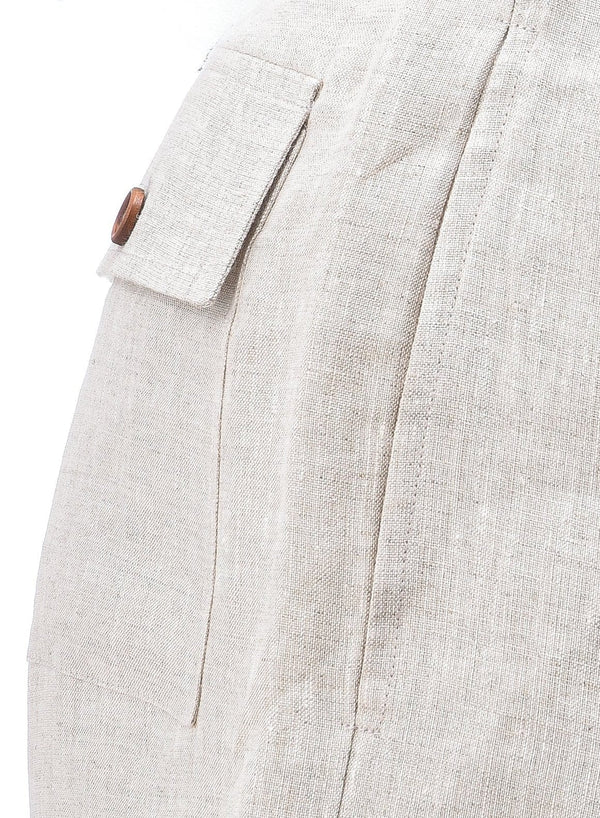
Stitch Density in a Linen Shirt — Count the Stitches per Inch
Stitch Density in a Linen Shirt — Count the Stitches per Inch
Why a good linen seam is dense and flat at once.
Turn a shirt inside out, lay a ruler along a side seam and count the stitches in one inch. The figure is called stitch density, or stitches per inch, and in shirtmaking it is one of the oldest quiet measures of care. Stitch density in a linen shirt is worth understanding, because it says something real about how the garment was made, and because in linen the finest figure is not always the highest one.
The principle is simple. A seam sewn with many small stitches is finer to look at and more secure than one sewn with a few long ones, because the load is spread across more points and the line of the seam follows the cloth more closely. Shirts made at speed for the mass market are commonly sewn with longer stitches, often around ten to twelve to the inch, since every extra stitch costs machine time. Fine shirtmaking works with shorter stitches, frequently in the high teens or beyond on the visible seams. The difference shows at arm's length: a dense, even seam reads as a line; a sparse one reads as a series of dashes.
“You can see the time that went into a shirt if you look at the seams.”
— Pieter Petros, founderLinen complicates the rule. Flax fibre is strong but has very little stretch, and a linen shirting is a firm, dry cloth. When it is sewn with a very high number of stitches, the thread can draw the cloth together slightly along the seam, producing a fine rippling known as seam pucker. On a cotton poplin this is rarely a problem; on linen it can be. A skilled maker therefore balances density against the cloth, choosing a stitch short enough to look fine and hold securely but not so short that the seam gathers. In linen, the evidence of quality is a seam that is both dense and flat.
That is why stitch density is best read alongside other signs. One is the seam construction: a flat-felled seam, in which the raw edges are folded in and stitched down, is cleaner and stronger than an overlocked edge. The buttonholes are another. A good buttonhole is sewn with a close, even stitch around its whole edge, with no loose threads and no fraying of the cut, and it is often the densest stitching on the shirt. The yoke, the collar and the cuffs complete the picture.
To check a shirt, look first at the evenness of the stitch rather than the count alone. Every stitch in a well-made seam is the same length, the line is straight, and the thread tension is consistent, so the stitch looks the same on both sides of the cloth. Then look at the places where pucker shows first: along the collar edge, down the front placket and around the armhole. A linen shirt that lies flat at these points has been sewn by someone who understood the cloth. Only then count the stitches, as a final confirmation.
Thread matters too. A fine shirt is sewn with a thread whose weight suits the cloth, strong enough to hold the seam without standing proud of the surface, and in a colour that matches closely or is chosen deliberately. Heavy thread on a fine shirting is as much a fault as long stitches. The article on how to identify premium linen sets out the other marks of quality in the cloth itself, from the evenness of the weave to the character of the slubs.
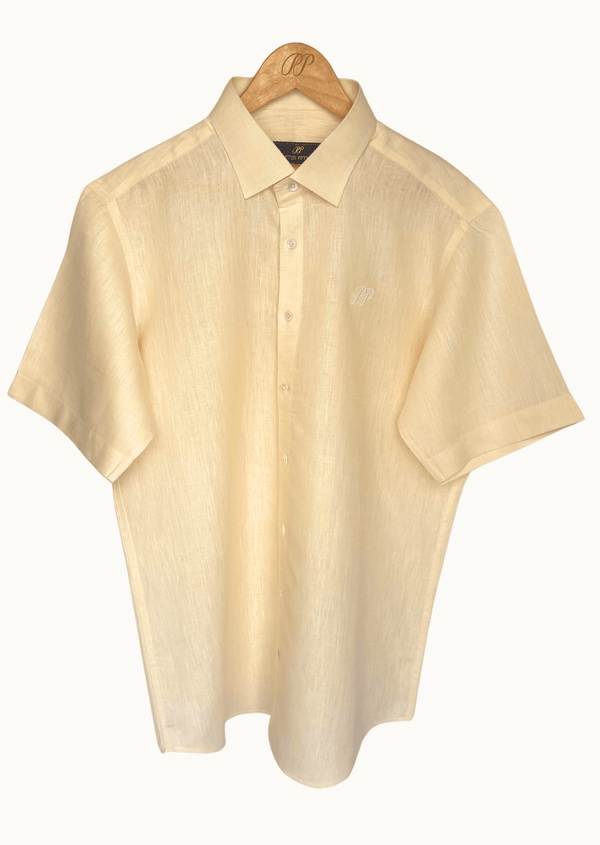
None of this can be read from a photograph. Stitch density, seam pucker and thread tension are qualities of the object in the hand, which is one reason that a shirt seen in a boutique tells you more than a shirt seen on a screen. Seams are worth reading closely when a shirt from the PP linen shirts is in the hand, and a truly handmade shirt shows its making at exactly these points.
Seams do not wear out quickly when they are sewn well. A linen shirt sewn with a balanced, even stitch will soften around its seams over years of wear, the cloth relaxing while the line holds, and the seams will often outlast the first sign of wear in the cloth itself.
Read more: The Yoke of a Linen Shirt · The Placket of a Linen Shirt