The Linen Shirt Yoke — What It Says About How a Shirt Is Made
The Linen Shirt Yoke — What It Says About How a Shirt Is Made
Single, double or split: what the panel behind the collar says about how a shirt was made.
Turn a shirt around and look just below the collar. Across the shoulders, from one sleeve to the other, runs a separate panel of cloth, joined to the back of the shirt by a seam a hand's width or so below the neck. This is the yoke. It carries the weight of the shirt from the shoulders, gives the back its shape and holds the sleeves in place, and in a linen shirt it matters more than in most. Understanding the linen shirt yoke is one of the simplest ways to judge how well a shirt has been made.
The yoke exists because the human back is not flat. The shoulders slope down and forward from the neck, and the upper back curves; a single flat piece of cloth from collar to hem would pull across the shoulder blades and hang poorly. By cutting the shoulders as their own piece, the shirtmaker can shape that piece to the slope of the shoulder and set the back panel below it to fall straight. The seam between them is where much of a shirt's fit is decided.
“The yoke is the part of a shirt nobody looks at, and the part that decides how it hangs.”
— Pieter Petros, founderThere are several ways to make a yoke, and each says something about the shirt. A double yoke uses two layers of cloth, an outer and an inner, with the shoulder and back seams enclosed between them. Inside the shirt, this leaves a clean finish with no raw edges at the shoulder, and it gives the area that bears the most load a little more body. A single yoke uses one layer, with the seams finished on the inside. A split yoke is cut in two halves that meet in a seam down the centre of the back; each half can be angled to follow its own shoulder, which allows a closer fit, and on striped cloth the meeting of the two halves shows as a small chevron. On plain linen the split is harder to see, but the shaping is still there.
Linen gives the yoke particular work to do. Flax fibre is strong but has little natural give, so a linen shirt cannot rely on the cloth to stretch across the back when the arms reach forward. The room has to come from the cut, and much of it comes from just below the yoke, where many shirts are given a box pleat at the centre or two pleats near the sleeves. Those folds open when you reach for a glass or turn the wheel of a car, and close when you stand. Linen also frays more readily than tightly woven cotton when its edges are left exposed, which makes enclosed seams, and a clean yoke seam in particular, a mark of care. Our piece on linen shirt seams looks at the rest of a shirt's construction in the same way.
How do you check a yoke? Five things are worth looking at. First, the line of the yoke seam across the back: it should run straight and level, with no puckering. Second, the inside: turn the shirt out, and the shoulder and yoke seams should be cleanly finished or enclosed. Third, the shoulder point: when the shirt is on, the seam where the sleeve meets the yoke should sit at the edge of the shoulder bone, neither falling down the arm nor pulled up onto the neck. That point is where fit begins, as the linen shirt fit guide shows. Fourth, the pleats, if there are any: they should be pressed and stitched evenly into the yoke seam. Fifth, the collar, which is sewn to the top of the yoke and depends on it to stand properly; the linen shirt collar guide covers what to look for there.
Little of this shows in a product photograph, which is why the yoke is one of the quieter signs of quality. The same eye, turned to the yarn and the finishing, is the subject of how to identify premium linen.
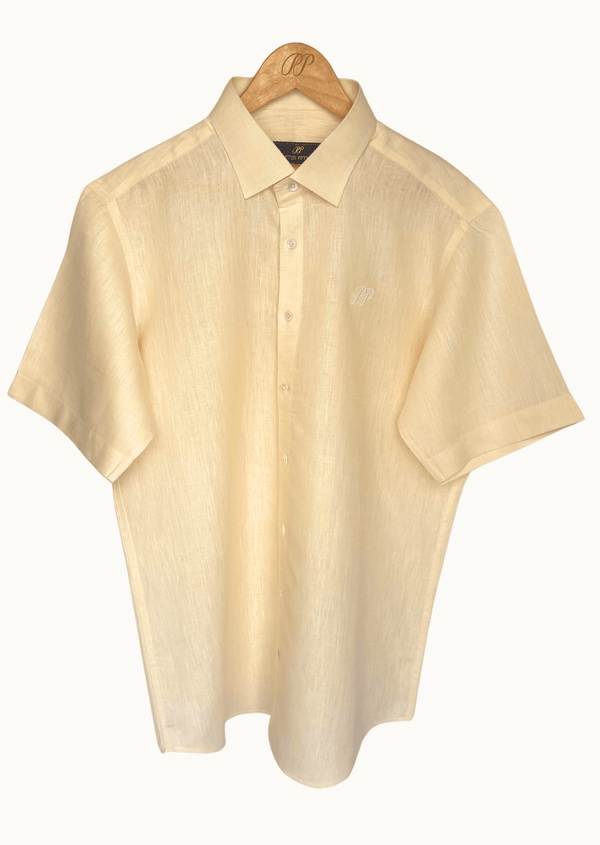
PP linen shirts are made by hand at the atelier in Dubai, and the yoke is part of that work: the panel that carries more of the shirt's weight than any other. The full range of shirts, from the Laos and the Bliss to the Monte-Carlo Male and the Vibes, is in the men's linen shirts collection. When one arrives, it is worth turning it around once, before it is worn, and looking at the line across the shoulders.
Read more: What It Means When a Shirt Is Truly Handmade · Linen Shirt Buttonholes