Linen Weave Types: What the Weave Tells You
Linen Weave Types: What the Weave Tells You
The same flax yarn can become a crisp shirt, a soft trouser or a tablecloth. The difference is in how the threads cross.
Hold a linen shirt up to a window and look closely. The light passing through it shows a grid: threads running lengthwise, the warp, and threads crossing them, the weft. How those two sets of threads interlace is the weave, and it shapes almost everything about the cloth, from how it feels to how it falls, how much air it lets through and how it ages. Understanding linen weave types is one of the quieter ways to judge a linen garment's quality, and one of the most useful.
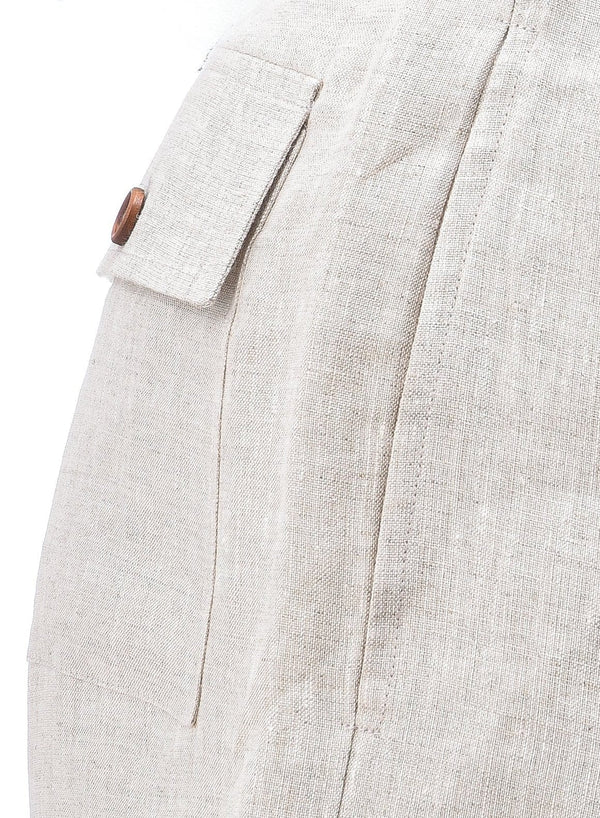
The plain weave is the foundation. Each weft thread passes over one warp thread and under the next, and the following row reverses it. The result is the simplest and most balanced structure in weaving: firm, crisp and breathable, with the texture of the yarn clearly visible. It is the usual weave for summer linen shirting, and it is where linen's natural slubs, the small thickenings in the yarn, show most clearly. A plain weave that is even, with no gaps or crowded patches, is a sign of good yarn and careful weaving.
“The weave is the part of a cloth that cannot be hidden.”
— Pieter Petros, founderThe basket weave doubles the plain. Two or more weft threads pass together over two or more warp threads, making small squares that look, at close range, like woven basketry. Hopsack and panama are versions of it. The cloth is more textured and more open than a plain weave of the same yarn, which makes it airy and slightly springy, a weave often found in summer jackets and trousers.
The twill weave sets the crossing points on a diagonal. Each weft passes over two or more warp threads before going under, and each row steps one thread along, creating the fine diagonal ribs familiar from denim and chino. In linen, twill gives a denser, softer cloth that drapes more fluidly and creases a little less sharply than a plain weave. It suits trousers and jackets more than shirts.
Herringbone is a twill that reverses direction at regular intervals, producing a zigzag that resembles the bones of a fish. In linen it is a heavier, more structured cloth, with a subtle surface pattern visible at arm's length, often used for summer tailoring. Its interest lies as much in the play of light across the reversing ribs as in the pattern itself.
Damask is linen at its most decorative: a woven pattern, usually made on a jacquard loom, in which areas of different weave catch the light differently, so that a motif appears on a cloth of one colour. It is the weave of fine table linen rather than of clothing, and it belongs to a long European tradition in which Flanders played a celebrated part.
Gauze, and its cousin leno, sit at the open end of the scale. The warp threads twist around each other between the wefts, locking them in place and allowing a very open, light cloth that still holds together. Linen gauze is airy and translucent, used for scarves, curtains and the lightest summer pieces.
Knowing the weave helps in reading a garment. A shirt in a fine, even plain weave will feel crisp, breathe well and soften steadily over years. A trouser in linen twill will drape and move. When judging any linen piece, hold it to the light to see the structure, feel whether the surface is even, and note its weight; linen fabric weight and the density of the yarn matter as much as the weave. Thread count, so often quoted for cotton, says much less about linen, as linen thread count explains.
The weave is only one marker among several, alongside the length of the flax fibre, the quality of the yarn, the finishing and the making. The certificate that accompanies certified Belgian linen speaks for the flax and for the cloth it became. The weave speaks for itself, to anyone with a window and a moment of attention.
Read more: Linen Slubs · Long-Staple Linen Fibre · How to Identify Premium Linen