Khadi vs Linen — Are They the Same? The Difference Explained
Khadi vs Linen — Are They the Same? The Difference Explained
Gandhi's spinning wheel, the flax field, and the two places where the hand enters cloth.
No — khadi and linen are not the same. Linen is cloth woven from the flax plant; khadi is cloth spun by hand and woven by hand in India, most often from cotton.
Linen and khadi are often mentioned in the same breath by people who care about natural cloth, but they are not the same kind of thing. Linen is defined by its fibre: it is cloth woven from flax. Khadi is defined by its making: it is cloth that has been spun by hand and woven by hand, most often from cotton in India, though khadi silk and khadi wool exist too. A comparison of linen vs khadi is therefore a comparison between a material and a method, and each has a good deal to say about how cloth feels on the body.
Why khadi and linen are so often confused
The confusion is easy to understand. Both are natural cloths, both are breathable and worn in the heat, both have a slightly irregular, textured surface, and in India both are sold side by side as summer fabric. A plain cotton khadi shirt and a linen shirt can look close at a glance. But the words answer different questions: "linen" tells you what the cloth is made of, "khadi" tells you how it was made. Linen does not mean khadi, and khadi does not mean linen.
Khadi: a cloth defined by the hand
Khadi's story is inseparable from India's. In the independence movement of the 1920s, Mahatma Gandhi made the spinning wheel, the charkha, a symbol of self-reliance, urging Indians to spin their own yarn and wear their own cloth rather than imported mill fabric. Khadi became a political garment as much as a textile. Today it is supported and certified in India by the Khadi and Village Industries Commission, and the word still means the same thing: yarn turned by hand, cloth woven on a hand loom.
“Every honest cloth carries a trace of where it came from. In khadi it is the spinner's hand; in linen, the field.”
— Pieter Petros, founderLinen: a cloth defined by the flax
Linen begins elsewhere. Flax is a bast fibre, drawn from the stem of the plant through a sequence of retting, scutching and hackling. The long fibres that result are strong and smooth, with a natural lustre, and most fine linen today is spun on machines, often wet-spun for a finer and more even yarn, and then woven on modern looms. The character of linen, its coolness and its crispness, comes from the fibre itself. The journey from seed to cloth is traced in how linen is made.
The difference between khadi and linen
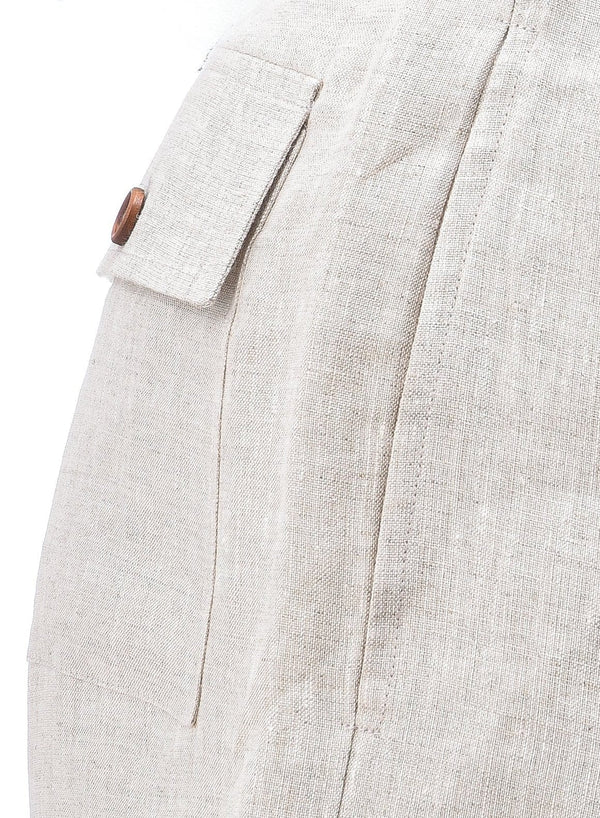
Texture is where the two meet. Hand-spun yarn is never perfectly even, and khadi carries those irregularities in its surface, a soft unevenness that makes each length of cloth slightly different from the next. Linen carries its own irregularities in the form of slubs, small thickenings that come from the flax fibre rather than the hand. Both cloths look alive because neither is perfectly uniform, and both soften with wear and washing.
To the hand, they differ. Cotton khadi is soft and full, with a slightly coarse, dry touch when new and a gentle warmth against the skin. Linen is cooler on first contact, crisper and smoother, with a more pronounced drape and a tendency to hang clear of the body. Both crease; linen's creases are sharper and more visible, khadi's softer and more rounded. In the heat, both breathe through open, airy weaves. Linen takes up sweat readily and lets it go fast, which gives it the edge in humid climates; khadi cotton holds moisture a little longer and feels softer while it does.
Put side by side, the differences come down to four things. The fibre: linen is always flax, khadi is usually cotton but can be silk or wool. The making: khadi must be hand-spun and hand-woven, while linen may be spun and woven by hand or by machine. The feel: linen is cooler, crisper and more lustrous, cotton khadi softer and warmer. The origin: khadi is an Indian cloth by definition, while fine linen is most closely associated with the flax fields of north-western Europe.
Where the hand enters
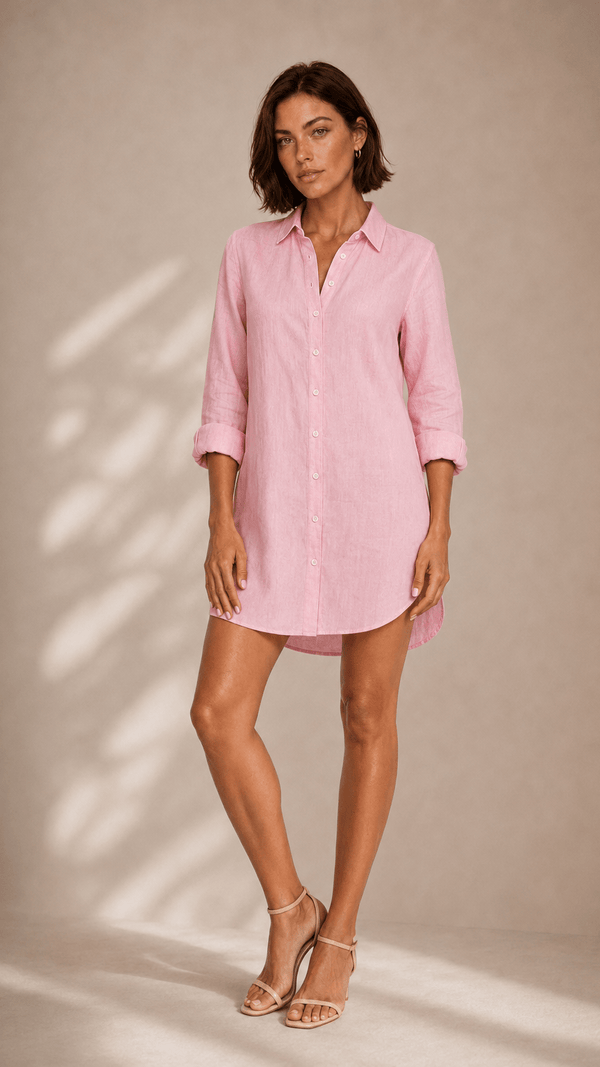
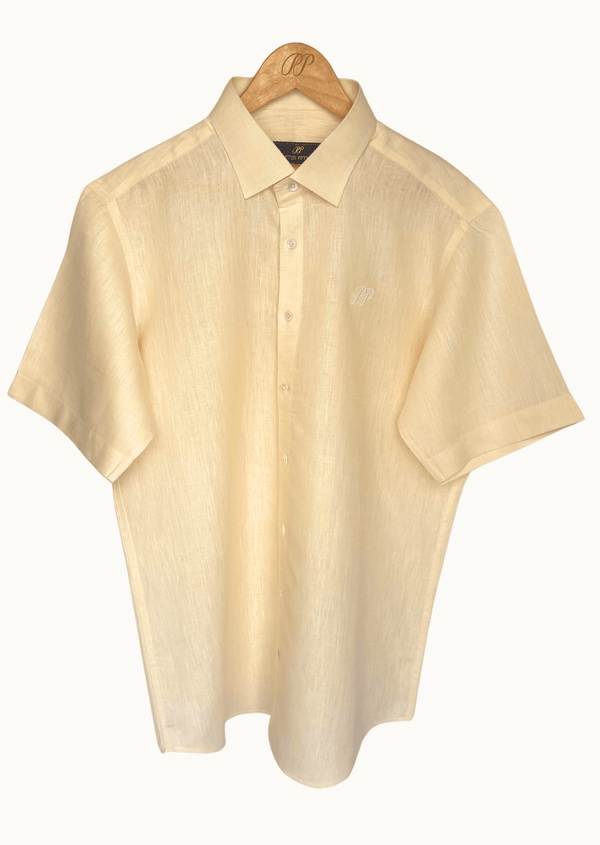
Where the hand enters is the most interesting difference. In khadi, it enters at the beginning, in the spinning and the weaving. In a Pieter Petros garment it enters at the other end. Much of the cloth is certified Belgian linen, woven by mills from flax grown in north-western Europe, and the hand takes over when each garment is made, in PP's Dubai atelier or in Belgium. Both are forms of handwork; they simply sit at different points between the plant and the person wearing it. The results can be seen in the men's linen collection and the women's linen collection.
Khadi or linen: which to choose
Choosing between them is rarely a matter of one being finer than the other. Khadi is the cloth of a particular history and a particular kind of making, deeply rooted in India and still woven there village by village. Linen is the cloth of a particular plant, widely regarded as finest from the coastal flax fields of Europe, with a history that reaches back beyond ancient Egypt. Linen in India has a story of its own beside the country's great cotton tradition. For a broader comparison with cotton in general, linen vs cotton sets out the differences fibre by fibre.
Worn in the same heat on the same afternoon, the two cloths would both do the work; what differs is the record each keeps of how it was made.
Read more: Linen vs Muslin · Linen vs Hemp · Is Flax the Same as Linen?