Linen Shirt Cuffs: What They Tell You
Linen Shirt Cuffs: What They Tell You
Interlining, pleats, placket and buttonhole: what to check at the wrist of a linen shirt.
Turn back the sleeve of a long-sleeved shirt and the cuff will tell you most of what you need to know about how it was made. It is a small piece of work, a band of doubled cloth joined to the end of the sleeve, but it gathers several difficult operations into a few centimetres: an interlining, a curved or straight edge, a join with the sleeve, a buttonhole and a button. Linen shirt cuffs are especially revealing, because linen is a cloth that shows every decision made with it, and a cuff made carelessly in linen looks careless within a week.
Most shirts carry a barrel cuff, a single band that wraps the wrist and closes with one or two buttons; the French or double cuff, folded back on itself and closed with cufflinks, belongs to formal shirts and is rare in linen, whose character is relaxed. Within the barrel cuff there are many small variations: square, rounded or mitred corners, one button or two, a cuff that is deeper or narrower. None is right or wrong. What matters is how well the chosen form has been made.
“The wrist is where a shirt meets the hand, and the hand notices everything.”
— Pieter Petros, founderThe first thing to feel is the interlining, the layer of stiffening inside the cuff. A fused interlining is glued to the cloth with heat, giving a flat, firm cuff that stays crisp but can feel rigid and may in time bubble where the bond loosens. A sewn or soft interlining is stitched in, or left out altogether, giving a cuff that rolls and bends with the wrist. For linen, a soft cuff is the more natural partner: it lets the sleeve be turned back easily on a warm afternoon and keeps the relaxed character of the cloth. Press a cuff between finger and thumb and it should feel like doubled fabric, not like card.
Next is the join between sleeve and cuff. The sleeve is wider than the cuff, so its fullness must be taken in, either with small pleats or with an even gathering. Pleats should be neat, evenly spaced and pressed in the same direction; gathering should be fine and regular, with no single puckered fold. Look at the inside as well: the raw edges of the sleeve should be enclosed within the cuff, with no fraying threads, and the line of stitching that closes the cuff should be straight and close to the edge.
The sleeve placket, the short opening above the cuff that allows the hand through, is the third clue. On a well-made shirt it is finished as a narrow strip of cloth, sometimes closed with its own small button halfway up so that the forearm does not show through the gap. Its top end should be cleanly finished, often with a small triangle or a square of stitching that stops it tearing. The linen shirt placket looks at the same care on the front of the shirt, and linen shirt seams at the stitching that holds it together.
Then the buttonhole and the button. The buttonhole on a cuff takes more strain than any on the front, opened and closed every time the shirt is worn, so its stitching should be dense, even and clean, without loose threads at the ends; linen shirt buttonholes explains what to look for. The button should be sewn with a short shank, so that it sits slightly proud of the cloth and closes without pulling. A natural button, of seashell or wood, is a sign of a maker who has thought about the whole garment.
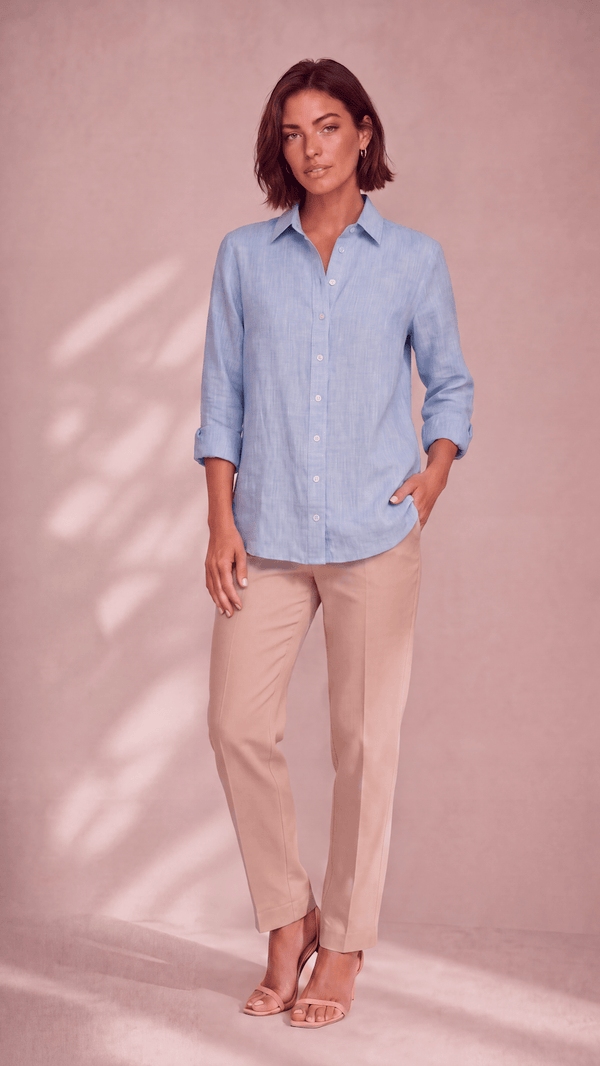
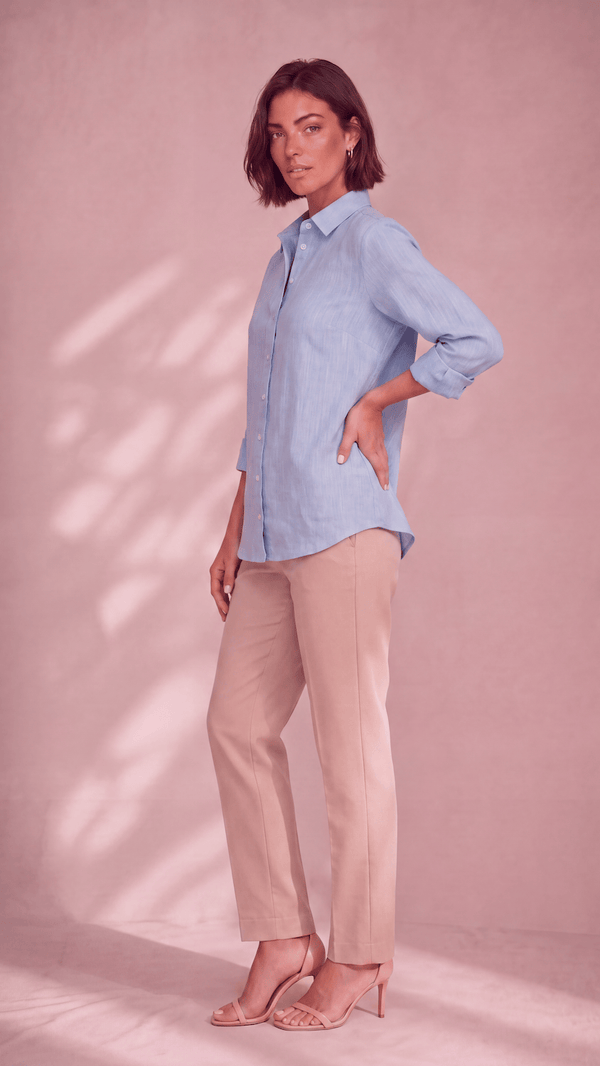
Finally, try the cuff on. It should close comfortably around the wrist with room for a watch, without sliding over the hand, and it should sit at or just past the wrist bone with the arm at rest. Roll the sleeve twice: a good linen cuff folds cleanly and stays where it is put. In the Pieter Petros collection, the Bliss Linen Shirt and the Laos Long Sleeve Linen Shirt are both long-sleeved, and both close with natural seashell buttons. The question of whether a long sleeve is right for a given climate at all is weighed in short sleeve vs long sleeve linen shirt.
A cuff takes more wear than any other part of a shirt, brushing against desks, table edges and the face of a watch every day, and the fold at its edge is often the first part of a shirt to show its age.
Read more: The Linen Shirt Yoke · The PP Bliss Shirt Guide