Linen Shirt Collar Interlining — Why Some Collars Sit and Others Sag
Linen Shirt Collar Interlining — Why Some Collars Sit and Others Sag
The layer no one sees, and the reason a collar still frames the face after a hundred washes — or doesn't.
Inside the collar of almost every shirt there is a hidden layer. Shirtmakers call it interlining or interfacing: a piece of stiffer cloth placed between the upper and under collar, and often inside the collar stand and the cuffs, to give them shape. In a linen shirt collar, interlining matters more than in most, because linen itself is crisp at first and soft later, and the collar has to stay composed through both stages of its life.
A collar without any support will roll and lose its points quickly; one with too much will stand like cardboard and sit awkwardly against a relaxed linen body. The craft lies in matching the support to the cloth and to the intended character of the shirt — firm for a shirt meant to be worn under a jacket, softer for a shirt meant to be worn open at the neck on a terrace.
“The parts of a garment no one sees are where you learn how it was made.”
— Pieter Petros, founderFused interlining. Most shirts today use a fusible interlining, a support fabric coated with a heat-activated adhesive and pressed onto the collar cloth. It is quick and consistent, and on a well-made shirt it produces a clean, smooth collar. Its weakness shows over time. If the bond is poor, or the shirt is washed too hot, the adhesive can let go in patches, and the collar develops small bubbles or a puckered, rippled surface that no iron fully cures. On linen, which moves and relaxes more than cotton, a stiff fused layer can also make the collar look out of keeping with the softening shirt around it.
Sewn interlining. The older method stitches the interlining in place rather than gluing it, so it floats between the two layers of collar cloth. It takes more time and skill, and the collar it produces is a little softer, with a gentle roll at the fold. Because nothing is bonded, there is nothing to come unstuck; the collar ages with the shirt rather than against it.
Soft and unlined collars. Some linen shirts use a very light interlining, or none at all, for a deliberately relaxed collar that lies open. Resort shirts and camp-collar styles often take this approach. The collar will crease and fold, and that is the intention; it belongs to the shirt worn open over swim shorts, not to the one worn with a tie.
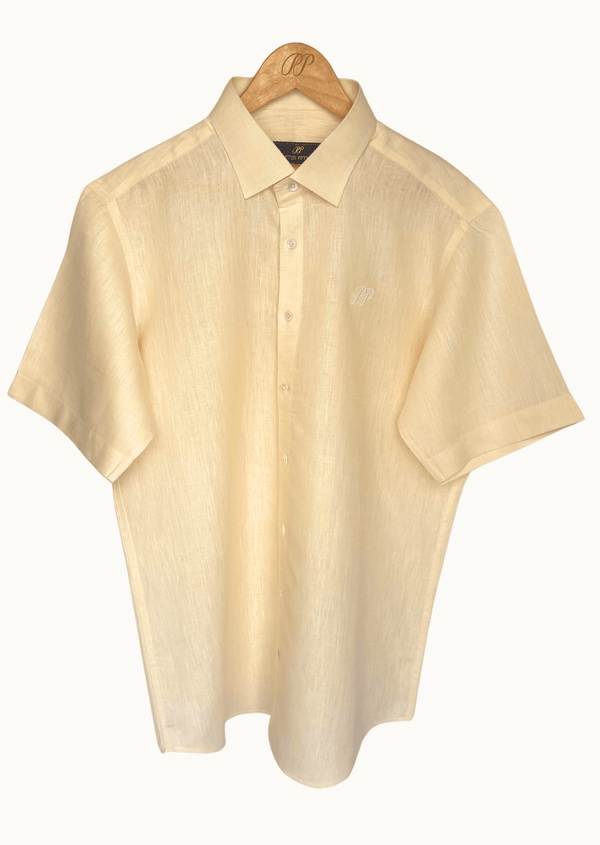
Learning to check the collar takes a few seconds. Hold it up to the light and look for an even, smooth surface with no ripples. Pinch the collar point gently: a good collar is springy, returning to shape, rather than rigid or limp. Fold the collar along its roll line and see whether it turns cleanly. On a shirt that has been worn and washed, look for small bubbles near the points and along the edge — the clearest sign of a bond that has failed. Spread, cutaway and button-down are compared in the linen shirt collar guide.
The collar works together with the other structured parts of the shirt: the placket, where the buttons run, and the yoke across the shoulders. A shirt in which these three agree — the same degree of support, the same intended character — looks whole. One in which the collar is stiff and the placket is soft, or the reverse, looks assembled.
Pressing matters as much as washing: the collar is pressed from the underside first, points inward, as described in how to iron a linen shirt.
These details reveal themselves in the hand, which is why the resort boutiques — from Park Hyatt Dubai to Tiziano Brunetto in Santa Margherita Ligure — are worth a visit. Lift the collar of a shirt from the men's collection, press the point between finger and thumb, and the craft of the whole shirt becomes clear in a moment.
Read more: Linen Shirt Buttonholes · Linen Shirt Stitch Density