Does Linen Make You Sweat — What Natural Fabric Does in Heat
Does Linen Make You Sweat — What Natural Fabric Does in Heat
Does linen make you sweat — the mechanism, comparison to synthetic, honest performance limit.
Linen does not make you sweat more than other fabrics — it manages perspiration more effectively than most alternatives in sustained heat. Understanding the mechanism clearly removes the confusion that the question often contains.
What actually causes sweating. Sweating is a physiological response to body temperature — the body sweats when its core temperature rises, regardless of what fabric is being worn. No fabric prevents sweating; the relevant question is whether the fabric manages the perspiration that occurs. Linen manages it more effectively than cotton and significantly more effectively than synthetic fabrics in sustained heat above 25 degrees.
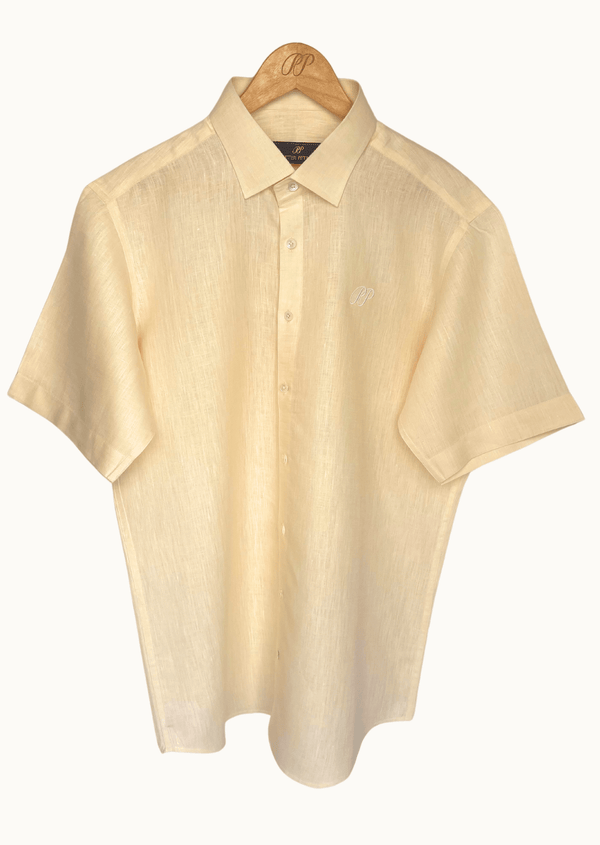
“Linen does not make you sweat more — it manages perspiration more effectively than most alternatives. The hollow-core flax fibre absorbs quickly and evaporates quickly. The result: a PP linen shirt feels dry more quickly than the equivalent cotton shirt.”
— Pieter Petros, founderHow linen manages perspiration. The hollow-core flax fibre of certified Belgian linen absorbs moisture (perspiration) quickly and releases it through evaporation into the surrounding air equally quickly. The absorption-evaporation cycle happens faster in linen than in cotton because the longer staple fibre of certified Belgian linen produces a more open weave that allows greater air circulation. The result is that a PP linen shirt feels dry more quickly after perspiration than the equivalent cotton shirt — the perspiration is not prevented but it is moved away from the skin more rapidly.
What synthetic fabrics do. Polyester and other synthetic performance fabrics are hydrophobic — they resist moisture absorption. Perspiration sits on the surface of the synthetic fabric or against the skin beneath it, where it does not evaporate readily and produces the damp, clammy feeling that synthetic shirts produce in sustained heat. Certified Belgian linen does the opposite: it absorbs, then evaporates, then feels dry.
The honest limitation. In extreme heat — above 38 degrees, with high humidity — a PP linen shirt will show perspiration marks in the conventional positions (underarms, back) if worn for an extended period without air conditioning. This is the material's honest performance limit. In these conditions, the linen still manages perspiration better than synthetic alternatives; it simply cannot eliminate the visible signs of heavy perspiration.
Does Linen Breathe · Best Linen Shirt for Hot Weather · Men's Linen Collection