How Is Flax Grown — The Hundred Days Before Linen
How Is Flax Grown — The Hundred Days Before Linen
From a seed in cold spring soil to a field of blue flowers: the season that decides the quality of the cloth.
Every linen shirt begins as a season in a field. Flax for fibre is an annual plant, sown in spring and harvested in summer, and in the cool, damp coastal belt that runs from Normandy through Belgium into the Netherlands it completes its whole life in roughly a hundred days. How flax is grown in those months — how densely it is sown, how much rain falls, when it flowers — shapes the length, fineness and strength of the fibre.
Fibre flax is not the same crop as the flax grown for linseed. Both are Linum usitatissimum, but fibre varieties are bred to grow tall and straight with few branches, putting their energy into the stem rather than into seed. It is the stem that matters: its outer layer holds the long bast fibres that become linen yarn.
“The quality of a shirt is decided in a field in spring, long before anyone threads a needle.”
— Pieter Petros, founderSowing happens from around mid-March to mid-April, as soon as the soil has dried enough to work. The seed is sown densely, far more closely than a cereal crop, so that the plants grow upright and slender and compete for light by growing tall rather than branching. A fine, level seedbed matters, because an even field produces even stems, and even stems produce even fibre.
Through April and May the crop grows quickly, reaching around a metre in height. The maritime climate of Western Europe suits it particularly well: frequent rain alternating with sunshine, moderate temperatures and no prolonged heat. In this belt the crop is generally rain-fed, needing little or no irrigation. In hot, dry climates elsewhere, flax often must be watered.
In June the field flowers. Each flower is a pale, clear blue with five petals, and each lasts for only a single day, opening in the morning and falling by the afternoon; the plant keeps producing new blooms over two or three weeks, so the field stays blue for a while. It is one of the most beautiful sights in Western European farming, and it is over within a few weeks.
After flowering, the seed bolls form and the stems begin to turn from green to yellow. When the lower part of the stem has yellowed and the leaves have dropped from the base, usually in July, the crop is ready. Flax for fibre is not cut but pulled, uprooted whole so that the fibre runs the full length of the stem to the root; that is how flax is harvested. The pulled stems are then laid in long swathes on the field for linen retting by the dew.
Rotation is the other quiet discipline of a flax grower. Flax is not sown in the same field year after year; a field typically returns to flax only after six years or so, with cereals, beet or potatoes in between. The long gap protects the soil and limits disease, and it is one reason the crop is regarded as a good neighbour in a farm's rotation.
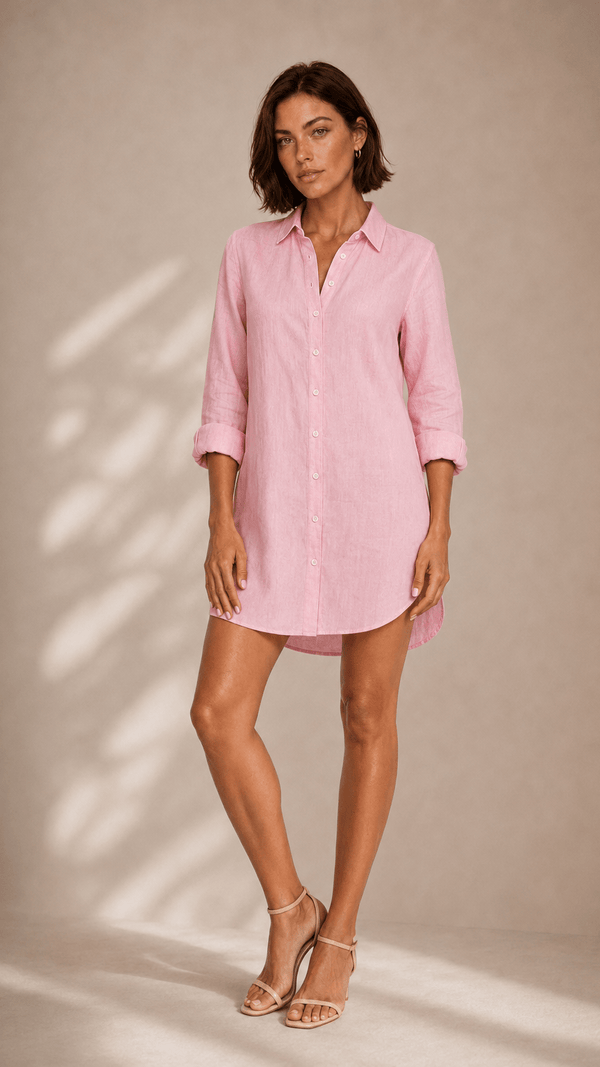
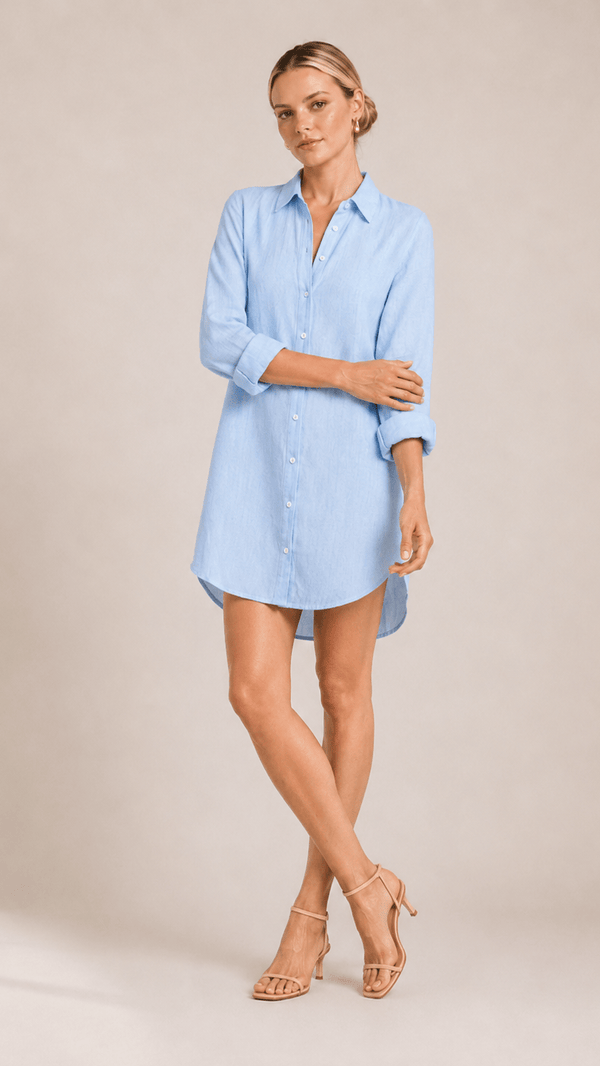
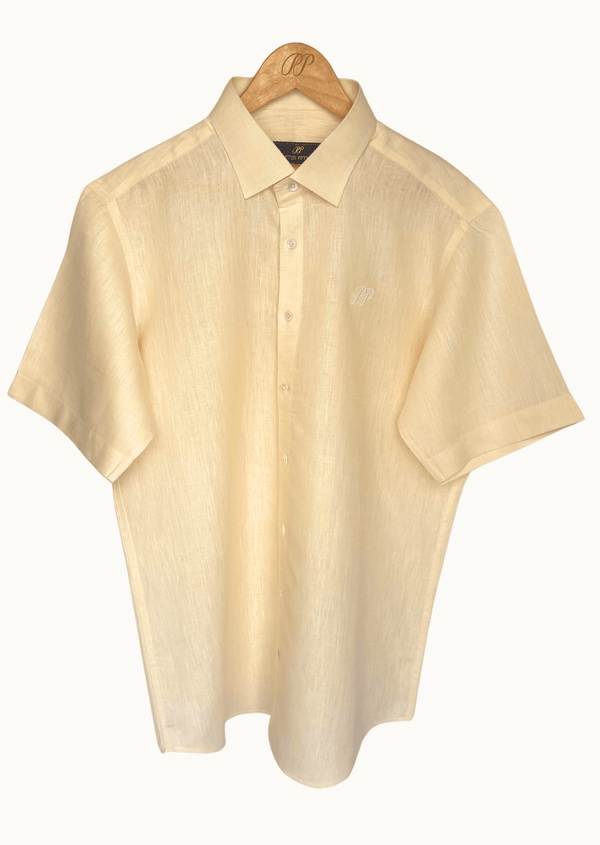
What does this mean for the cloth? Long, fine, even fibres come from a crop grown densely, in steady moisture and moderate warmth, and harvested at the right moment. Those are the conditions of the Western European coastal belt, which is why the region produces most of the world's fibre flax and why the Belgian Linen certification exists at all. The Belgian linen certificate follows the flax from the field to the woven fabric. The certified Belgian linen in the men's collection, and in five of the eight Amelia linen dress shirt colourways in the women's collection, begins in fields like these.
By late July the fields that were blue in June lie flat under rows of pulled stems, silver-grey and drying in the summer air, waiting for the dew to begin its work.
Read more: The 100% Belgian Linen Guide · How Linen Is Made