How Is Linen Woven — From Spun Flax Yarn to Finished Cloth
How Is Linen Woven — From Spun Flax Yarn to Finished Cloth
Flax yarn is stronger damp than dry, and the whole weaving room is built around that fact.
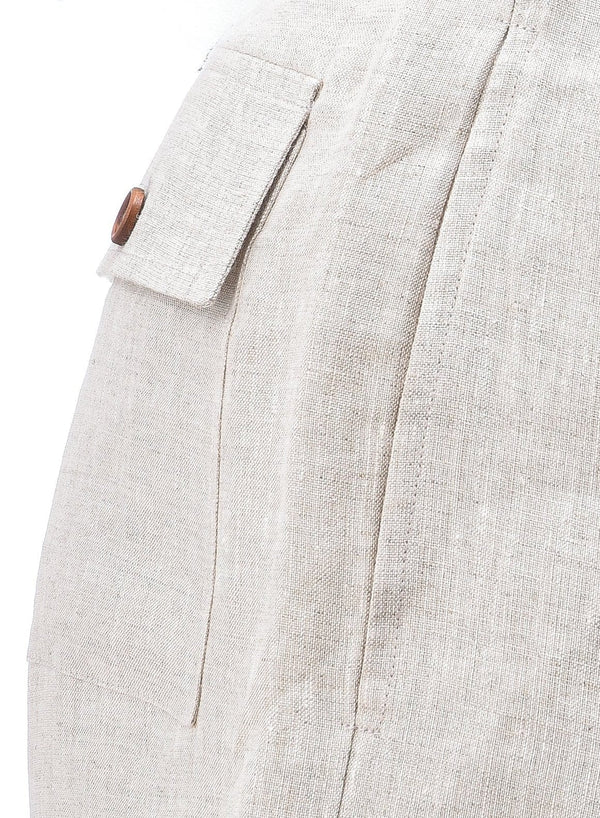
Linen is woven by interlacing two sets of flax yarn at right angles on a loom: the warp, which runs the length of the cloth under tension, and the weft, which passes across it from side to side. Most linen for shirting is woven in plain weave, the simplest structure, where each weft thread passes over one warp thread and under the next. That is the short answer to how linen is woven. The longer answer explains why linen cloth looks and feels the way it does.
Weaving comes late in a long sequence. The flax is grown, pulled, retted, scutched and hackled, then the long fibres are spun into yarn, a stage described in how linen is spun. Only then does it reach the weaving mill, wound onto cones and ready to become cloth.
“A cloth is a record of every hand that touched the fibre before it.”
— Pieter Petros, founderThe first task is preparing the warp. Hundreds or thousands of yarns are wound side by side onto a large roller, the warp beam, at an even tension. Because flax yarn has very little stretch, it is often sized, coated with a light starch, so that it can survive the constant friction of the loom without breaking. Each warp thread is then drawn through the eye of a heddle and through the reed, the comb-like frame that beats the weft into place.
On the loom, the heddles lift some warp threads and lower others, opening a gap called the shed. The weft yarn is carried through the shed, by a shuttle on older looms, by a rapier or a jet of air on modern ones, and the reed presses it against the cloth already woven. The heddles change position, the shed closes and reopens the other way, and the next pick of weft follows. The number of picks per centimetre, together with the number of warp ends, sets the density of the cloth, which is discussed in our note on linen thread count.
Flax has one unusual property that shapes the weaving room. The fibre is stronger when damp than when dry, so linen mills keep the air humid; in a dry room the yarn becomes brittle and breaks more often. This is one reason flax weaving grew up in the moist climates of Flanders, Ireland and northern France. The slight irregularities of the yarn, the small thickenings known as slubs, pass straight into the cloth and give linen its characteristic surface.
Plain weave is not the only structure. Herringbone, twill and the open, gauze-like leno weave are all possible in flax, and each changes the drape, the weight and the way the cloth moves. The guide to linen weave types sets them side by side. For a shirt meant for heat, a well-balanced plain weave remains the classic choice: open enough to breathe, firm enough to hold a collar.
Woven cloth leaving the loom, known as greige, is stiff and pale grey-brown. It is then washed to remove the size, and may be bleached, dyed and finished. Finishing can soften the hand or leave it crisp; it decides much of how the cloth feels on the skin.
The Belgian Linen® certification follows the flax from the field in Western Europe through to the woven fabric, which is why weaving is part of what the mark records. Where a PP linen shirt is made from certified Belgian linen, the cloth arrives at the atelier with that trace from flax to fabric already recorded; there the garments are cut and sewn.
Read more: What Is the Belgian Linen Certificate · Linen Slubs