Ramie Fabric vs Linen — How a Ramie Shirt Really Wears
Ramie Fabric vs Linen — How a Ramie Shirt Really Wears
Linen vs ramie — two natural plant fibres compared on surface, durability, wrinkling, softening behaviour, and long-term wearability.
A ramie fabric shirt is woven from the stem fibre of the ramie plant, a perennial of the nettle family long known as China grass. It is lustrous, crisp and strong when new and breathes well in heat, but it creases sharply, softens less with washing than linen does, and its fibre can turn brittle where the cloth is folded in the same place again and again.
Linen and ramie are both natural plant fibres that share several surface-level similarities — they are both cellulosic, both relatively strong, and both used in warm-weather clothing. The differences between them, however, are meaningful enough that understanding them helps in making a considered fabric choice.
Fibre origin. Linen is made from the stem fibres of the flax plant. Ramie is made from the stem fibres of the ramie plant, also known as China grass, which is grown mainly in China, with smaller crops in the Philippines, elsewhere in Asia and in Brazil. Both plants produce bast fibres — fibres extracted from the stem rather than the seed.
What is ramie fabric made of?
Ramie fabric is made of the long bast fibre that lies under the bark of the ramie stalk, held together by a heavy natural gum. Before it can be spun, the stalks are stripped and the fibre is degummed, usually in an alkaline bath — a more intensive step than the retting that frees flax fibre for linen (the difference between the plant and the cloth is set out in is flax the same as linen). The cleaned fibre is long, white and naturally glossy, which is why ramie cloth catches the light the way it does. A ramie field can be cut several times a year, whereas flax is sown and pulled from the ground once a season.
“Certified Belgian linen improves progressively with each correct wash cycle. This improvement trajectory is the quality that most distinguishes it from ramie, cotton, or synthetic alternatives.”
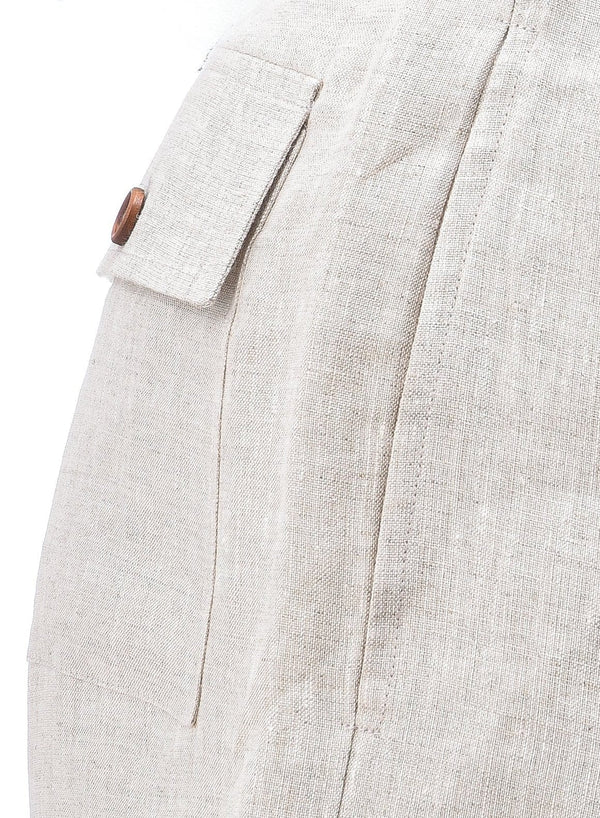
— Pieter Petros, founderSurface and texture. Ramie has a naturally high lustre — the fibre has a silky surface quality that linen does not. Fresh ramie fabric looks almost shiny compared to linen. This lustre fades with washing, and ramie can become somewhat coarser over time rather than softer. Linen's surface is more matte and slightly textured when new, but improves progressively with each correct wash cycle — becoming softer, more fluid, and more refined over time.
How a ramie fabric shirt wears
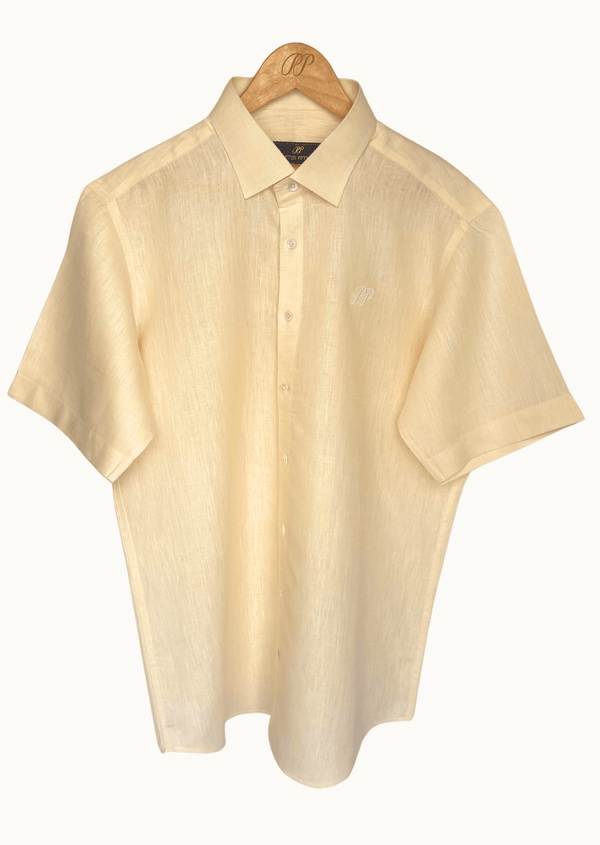
On the hanger, a ramie shirt looks sharp: the sheen gives it a dressed quality and the crisp hand holds a collar well. Worn through a warm day, the same stiffness means it stands away from the body rather than following it, and the creases that form at the elbows and across the back stay defined. A linen shirt starts more matte and a little firmer than it will become, then relaxes into the shape of the wearer over successive washes.
Durability. Both fibres are strong, but linen — particularly long-staple certified Belgian linen — has better durability under repeated washing and wear. Ramie is prone to fibrillation — the surface fibres can separate and pill with extended use — to which linen is far less prone.
Is ramie durable enough for a dress worn weekly all summer?
For strength, yes. Ramie is among the strongest plant fibres and, like linen, it is stronger when wet, so a ramie dress copes with regular washing. Its weakness is flexibility: the fibre has very little give, so it can wear thin along lines that are folded or pressed in the same place week after week — collar points, cuffs, hems and the crease at the waist. Varying the fold, hanging rather than stacking, and washing on a gentle cycle at 30°C keep a ramie dress wearable through a season. How linen holds up over years of the same use is covered in is linen durable.
Wrinkling. Ramie creases even more readily than linen and has less natural drape. The wrinkle of a ramie garment is typically sharper and more resistant to relaxation than that of linen.
Does ramie wrinkle or shrink more than linen?
Both fibres crease; it is part of their nature, as does linen wrinkle explains. In a ramie blouse the creases are crisper and slower to fall out; in linen they are softer. On shrinkage the picture is different: ramie generally holds its dimensions well, while linen can relax slightly at its first washes, which is why the care advice in does linen shrink matters for a new linen piece.
Is ramie a good warm-weather fabric?
It is. Ramie absorbs moisture, dries quickly and lets air move through an open weave, so it is comfortable in heat in much the same way linen is. The difference is felt against the skin rather than measured: ramie stays crisp and slightly cool to the touch, while washed linen develops a fluid drape that moves with the body.
Ramie linen fabric and blends
Ramie is often blended — most often with cotton, sometimes with linen — to add lustre and crispness to a cloth. A fabric sold as linen ramie is therefore a blend, and the percentages on the label say how much of each fibre it holds. A third bast fibre, hemp, is compared in linen vs hemp.
Ramie fabric: good or bad?
Neither, in absolute terms. Ramie is a strong, lustrous, breathable natural fibre with a crisp hand; its limits are a sharp crease, a lustre that fades, and a fibre that can grow brittle at repeated folds. Those who want shine and structure on day one may like it. Those who want a garment that grows softer and more personal with every summer will find that in linen.
Availability. High-quality linen is produced in significant volume with a well-established certification system. Ramie at comparable quality is less consistently available and lacks the equivalent certification infrastructure of Belgian linen.
For warm-weather luxury dressing, Belgian linen is the more established and more reliably performing choice. Ramie is an interesting natural fibre but does not match the long-term wearability and improvement trajectory of quality linen.
Natural Fabric Types · Linen vs Cotton Shirt · Men's Linen Collection