Linen vs Cotton in Hot Weather — Which Performs Better?
Linen vs Cotton in Hot Weather — Which Performs Better?
Linen vs cotton in hot weather — the fibre comparison, dry heat, humid heat, and how the feel comparison reverses over time.
Linen and cotton are both natural fabrics that have been used in warm climates for millennia — and while both perform significantly better than synthetic alternatives in heat, they perform differently from each other in ways that matter when choosing the correct fabric for sustained hot-weather wear.
The fibre comparison. Linen is a bast fibre from the flax plant stem; cotton is a seed fibre from the cotton boll. The structural difference between these fibres produces different properties at the fabric level. Linen's hollow tubular fibre and characteristically open weave produce more airflow through the fabric in sustained heat. Cotton's denser fibre and tighter weave produce a fabric that feels softer initially but allows less airflow in direct comparison at equivalent weights.
“Cotton is softer than linen when new. This reverses over time with certified Belgian linen — the progressive softening that long-staple flax develops with correct washing means that after months of wearing, the PP linen shirt is softer than a cotton alternative.”
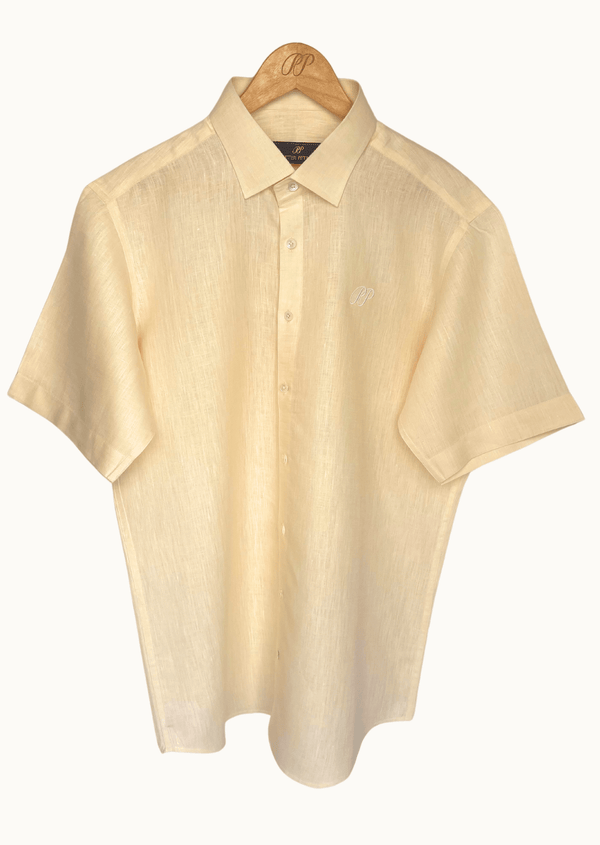
— Pieter Petros, founderIn dry heat above 30 degrees. Linen generally outperforms cotton in breathability in dry heat above 30 degrees. The open weave allows more air movement across the skin; the hollow fibre allows heat to escape through the fabric rather than being retained. In the Gulf's dry summer heat, a PP certified Belgian linen shirt at a midweight is generally regarded as more comfortable in sustained outdoor exposure than a comparable cotton shirt at the same weight.
In humid heat. In high humidity — Bangkok, Singapore, Miami in August — both linen and cotton manage moisture by absorbing perspiration. Linen's moisture absorption is higher relative to its weight than cotton's, and linen releases moisture more readily through evaporation. The practical difference in tropical conditions is that linen feels drier against the skin in sustained humid heat.
The initial feel. Cotton is softer than linen when new — the seed fibre has a natural softness that bast fibre does not. This reverses over time with certified Belgian linen: the progressive softening that the long-staple flax fibre develops with correct washing means that after several months of regular wearing, a PP Belgian linen shirt is softer than a cotton alternative that has not developed.
Linen vs Cotton Shirt · Is Linen Good for Summer · Men's Linen Collection