Does Linen Stain Easily? — What Really Happens and What to Do
Does Linen Stain Easily? — What Really Happens and What to Do
Which marks lift easily from linen, which need patience, and why the first few minutes count.
A glass of wine tips at a long lunch, and a drop lands on a pale shirt. Whether that drop becomes a stain depends less on the fabric than on the next few minutes. Does linen stain easily? Not especially: its long, smooth flax fibres give dirt little to cling to, and most marks lift in an ordinary wash. But linen is absorbent, and a liquid soaks into it quickly. The cloth that releases a stain readily is also the cloth that takes it in fast, and both facts shape how to look after it.
The smoothness comes from the fibre itself. Flax fibres are long and fairly straight, and spun into yarn they form a surface with fewer loose ends and less fuzz than many other natural fibres. Particles of dust and dry dirt sit on that surface rather than working into it, and they wash out without much effort. That is part of why linen has long been used for tablecloths and napkins, the cloths that meet food every day. The properties of linen as a fabric follow from the same fibre.
“A garment you are afraid to wear is not a luxury. Linen is meant to be lived in.”
— Pieter Petros, founderAbsorbency is the other side. Linen takes up moisture readily, which makes it so comfortable in heat, and it takes up a spilled drink just as readily. Water-based marks such as coffee, tea, juice and wine spread into the weave quickly, but because they are held in the fibre rather than bonded to it, they usually come out if treated before they dry. Blot, never rub: press a clean cloth or napkin onto the mark to draw the liquid out, then rinse the back of the fabric with cold water so that the stain is pushed out the way it came in.
Oils are harder. Olive oil, sun cream, body lotion and salad dressing are not dissolved by water alone, and on any natural fibre they can leave a darker patch that stays until a little detergent is worked in. Sun cream, the commonest mark on a holiday shirt, needs its own method: how to remove sun cream from linen.
Protein marks, such as egg or blood, set with warmth, so cold water comes first, and heat of any kind waits until the mark has gone. For a stubborn mark, removing stains from linen goes step by step.
Once the mark has been treated, the wash itself is simple and the same for every PP linen garment: a gentle cycle at 30°C, with a mild detergent. After washing, linen can be dried in the sun, in the shade or in the tumble dryer on a low setting.
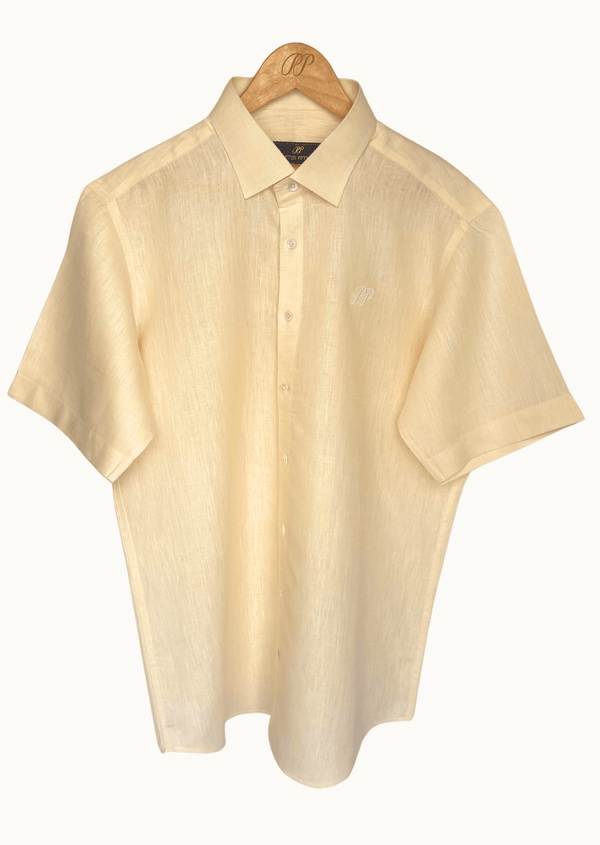
Colour changes how visible a mark is, not how likely it is. A Laos Short Sleeve Linen Shirt in White shows every drop at once, which has its advantage: the stain is noticed and treated while fresh. Deeper colourways such as Dark Blue, Dubarry or the Sapphire Blue of the PP Casual Linen Trousers hide small marks better. For long lunches by the sea, many of the men's shirts in the linen shirts collection come in both light and deep shades.
White linen has its own question, whether it yellows over time; that is answered in does white linen turn yellow. For everyday marks, the short version holds for every colour: act early, use cold water, keep heat away until the cloth is clean.
Read more: How to Wash Linen Shirts · The Linen Shirt Care Guide