The Grain Line of a Linen Shirt — Why Some Shirts Twist
The Grain Line of a Linen Shirt — Why Some Shirts Twist
An invisible line, drawn before the first cut, that decides how a shirt hangs for its whole life.
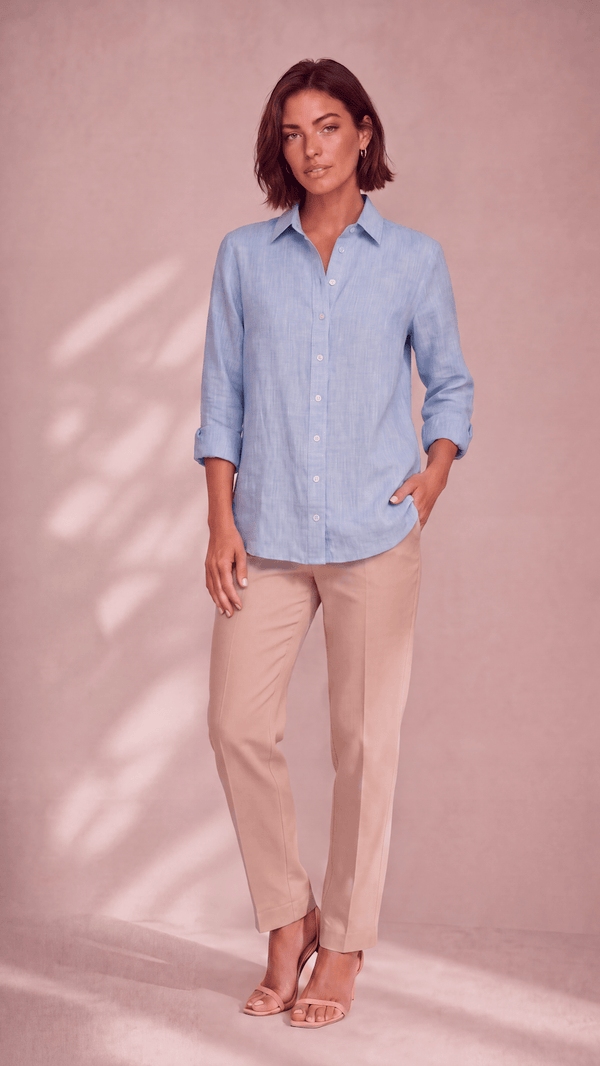
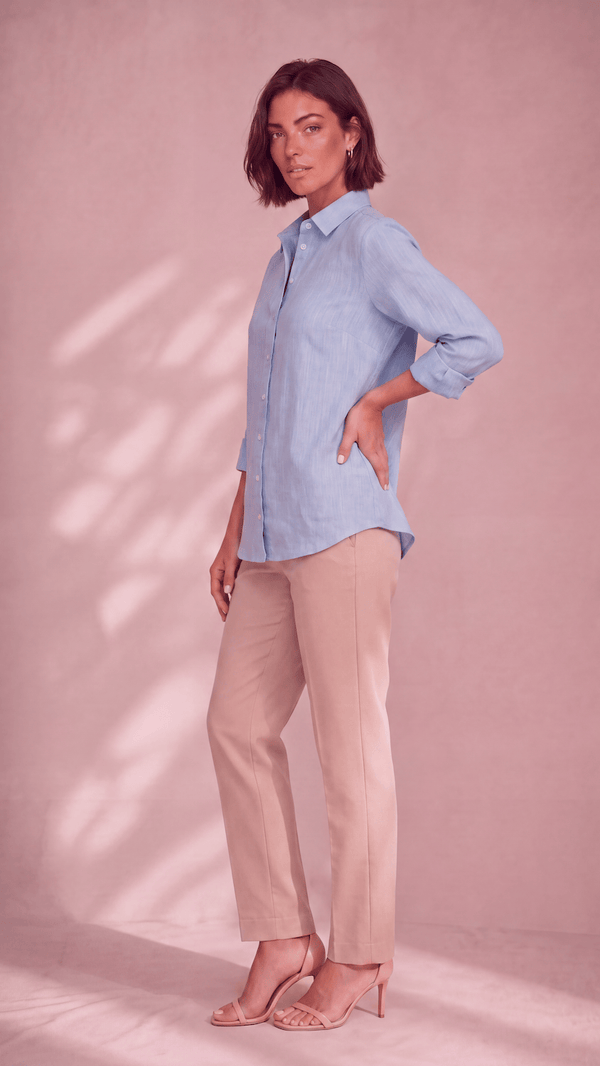
Hang two linen shirts side by side after a few washes. One falls straight from shoulder to hem, the side seams down the sides of the body, the placket down the centre. The other has begun to twist: a side seam has drifted towards the front, the hem dips on one side, and the front panels no longer meet as they did. The cloth may be the same. The difference is in how it was cut, and in particular whether the shirt was cut on the grain line.
Woven cloth is made of two sets of threads. The warp runs the length of the fabric, held under tension on the loom; the weft runs across it, from one edge, or selvedge, to the other. The grain is the direction of these threads. Straight grain, or lengthwise grain, follows the warp, and it is the most stable direction in the cloth: it stretches least and hangs straightest. Cross grain follows the weft. The bias runs diagonally at forty-five degrees, and it is the direction in which a woven fabric gives and drapes most.
“The decisions that matter most in a garment are usually the ones you cannot see.”
— Pieter Petros, founderOn a pattern piece, the grain line is the arrow that shows how the piece must be laid on the cloth. For a shirt, the front panels, the back and the sleeves are usually cut with the grain line running vertically, parallel to the warp. Laid exactly, the shirt hangs as it was drawn. Laid a few degrees off, to save cloth or time, it carries a small diagonal tension that the first washes release, and the garment slowly turns on the body.
Linen makes this especially visible. Flax fibre is strong and not very elastic, so linen has little give to hide a mistake; and because linen is often washed many times in a summer, any tension in the cut is released early. A linen shirt cut on grain keeps its line wash after wash. One cut off grain shows it within a season. The same care is visible in the seams of a linen shirt, which can only lie flat if the pieces they join were cut true.
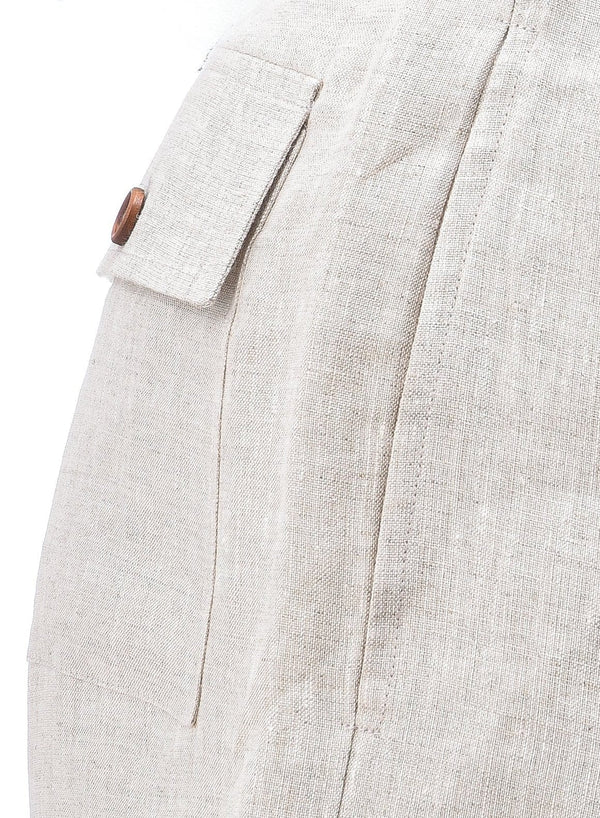
There is a second reason. Linen often has visible texture: slubs in the yarn and the slight irregularity of a natural fibre. On a shirt cut on grain, that texture runs straight down the body and across the sleeves, and the eye reads it as calm. On a shirt cut off grain, the lines run at a slant, and the garment looks subtly unsettled even before it is worn.
Some parts of a shirt are cut deliberately in other directions. A yoke may be cut on the cross grain, or in two pieces, to sit across the shoulders; the yoke is the subject of its own piece. Bias strips are sometimes used for binding a curved edge, because the bias bends smoothly around a curve. These choices are made on purpose and shown on the pattern.
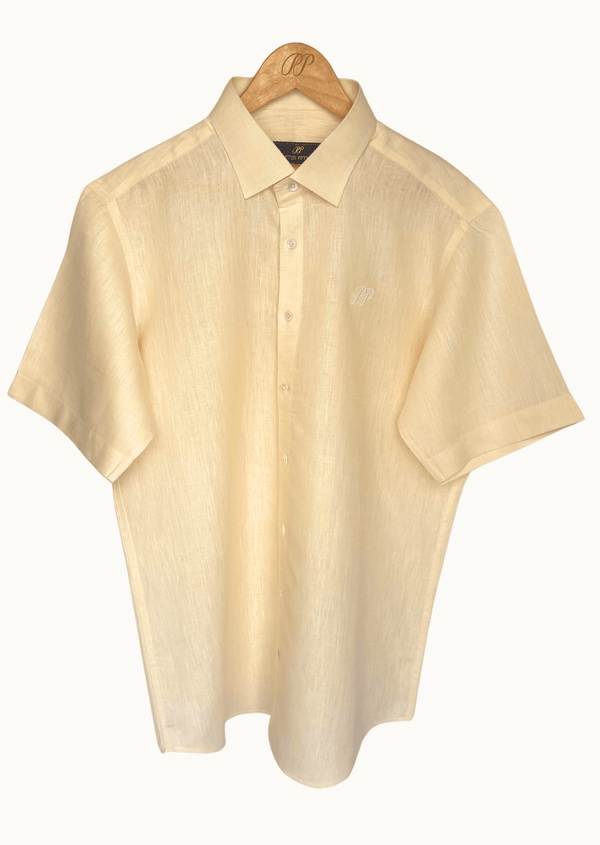
How can a reader see it? Look at a shirt hanging on a hanger. The centre front should fall vertically, and the side seams should hang straight down from the underarm to the hem. Look at the texture: on the back and the front panels, the slubs and the weave should run straight up and down. Turn the shirt inside out and look at the seams: they should be even along their whole length. And after the first few washes, a well-cut shirt will look the same; a poorly cut one will have begun to turn.
Cutting on grain takes more cloth and more time. The pieces cannot be packed on the fabric at angles to fill the gaps, and the fabric must be laid square before cutting, with the warp straight. It is one of the reasons a handmade shirt costs what it does, and one of the reasons it lasts.
At Pieter Petros, shirts are handmade in Dubai and in Belgium; the men's collection and the women's collection show the result on the body. Related details of construction, such as the placket, depend on the same exactness.
In the end, the grain line is the one quality that nobody notices on a good shirt and everybody notices on a poor one.
Read more: Stitch Density in a Linen Shirt · What Makes a Shirt Truly Luxury