Does Linen Have a Sheen? — Where Its Natural Lustre Comes From
Does Linen Have a Sheen? — Where Its Natural Lustre Comes From
From hackling to calendering, every stage changes how the cloth catches light.
Yes, linen has a sheen, though it is a quiet one. Hold a linen shirt to a window and the surface catches the light in a soft, uneven glow, brighter along the yarns and darker in the small irregularities between them. It is not the high shine of satin or the liquid gleam of silk, and it is not the flat, chalky surface of a brushed cotton. It sits between them, and it comes from the fibre itself rather than from anything added to it. Understanding where linen's lustre comes from is a good way of understanding the fibre.
Linen is spun from the stem of the flax plant. The fibres that run the length of the stem are long, often several tens of centimetres in the finest grades, and their surface is relatively smooth, marked only by small nodes at intervals. Cotton fibres, by comparison, are short and naturally twisted, like a flattened ribbon. A smooth, straight fibre reflects light in a more coherent way than a short, twisted one, and that coherence is what the eye reads as lustre.
“Good linen has a light of its own. It does not shine at you; it glows when the light falls on it.”
— Pieter Petros, founderThe length of the fibre matters as much as its surface. In linen production, the long fibres, called line, are separated from the short, tangled ones, called tow, during hackling. Line fibres are spun into the finer, smoother yarns used for shirting; tow goes into coarser cloths. The longer the fibres in a yarn, the fewer ends protrude from its surface, and the cleaner the light falls on it. The subject is explored in the piece on long-staple linen fibre.
Spinning adds to it. Fine linen yarns are usually wet spun: the fibres pass through warm water before they are drawn out, which softens the natural pectins that bind them and lets them lie closer together. The result is a smoother, more even yarn with a gentler shine than dry-spun linen.
Finishing can lift the sheen further. Historically, linen damask and fine table linen were beetled, pounded for hours by wooden hammers to flatten the yarns and close the weave, which gave them a deep, almost polished lustre. Today, calendering, pressing the cloth between heated rollers, does something similar. Washing does the opposite: a washed or softened linen has a quieter, more matte surface and a looser hand. Both are legitimate finishes; the difference is one of character.
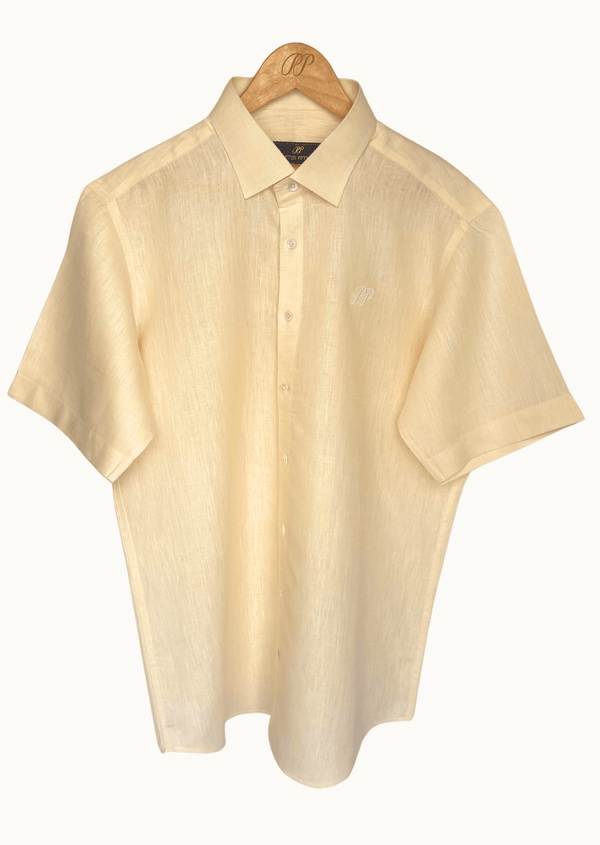
Colour changes how the sheen reads. On pale linens, oyster and vanille, the lustre is subtle and soft, part of what makes them look luminous in daylight. On deeper tones it becomes more visible, a gentle light along the folds. The Laos Long Sleeve Linen Shirt in Dark Blue or the Vibes Linen Shirt in Dubarry shows it well; both are in the PP linen shirts collection.
Wear changes it, too. As linen is worn and washed, the fibres soften and the surface relaxes. The crisp light of a new shirt gives way to something softer and more diffuse over the years, a change many people value as part of linen's character. It is one of the ways in which the cloth records its own history.
Can sheen be used to judge quality? Partly. A clean, even lustre on an unwashed linen usually points to long fibres and careful spinning; a dull, hairy surface with many protruding ends often points to shorter fibres. But a matte surface can also be a deliberate finish, so lustre is one sign among several. The hand feel of linen, the regularity of the weave and the provenance of the flax tell the rest of the story.
The sheen of linen is, in the end, a property of the plant. It comes from a fibre that grows long and straight in cool, damp fields such as those of Western Europe, is separated, spun and woven with care, and is left to show what it is. No coating produces it, and none is needed.
Read more: The Belgian Linen Guide · Linen Slubs